
All Brand Guides + −
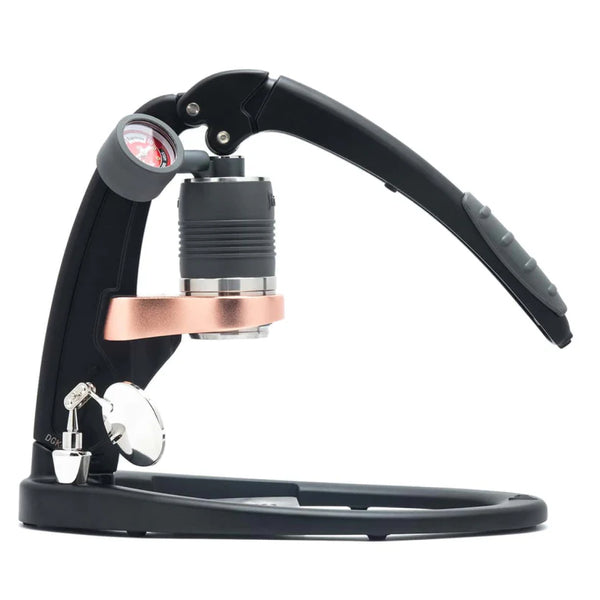
Flair Pro 3 Manual Espresso Machine
Setup & First Use
The Flair PRO 3 is a 100% human-powered lever espresso maker. It requires no electricity and produces no steam. To brew, you will need freshly roasted coffee beans, an espresso-capable burr grinder, and a kettle capable of boiling water. Blade grinders and pre-ground coffee will not produce good results.
Assembling the Frame
Lower the post into the base and insert the included bolt through the base into the threaded post. Tighten with the included hex key until the post is secure and does not wobble. Attach the articulating shot mirror to the circular magnetic coin on the left side of the base. Slide the stainless steel drip tray into the base. The frame is now assembled and ready for use.
Your First Shot
Grind 15–17 grams of freshly roasted beans with an espresso-capable burr grinder and add the grounds to the portafilter. Using the tamper, compress the grounds evenly on a level surface. Place the dispersion screen on top of the tamped grounds. Set the loaded portafilter into the PRO 3 frame.
Confirm the plunger is positioned at the top of the brew cylinder — use the dosing cup to slide it up if needed. Press the cylinder onto the portafilter. Insert the pressure gauge into the top of the plunger and rotate it to a comfortable viewing angle. Fill the cylinder with just-boiled water through the plunger opening. Lower the lever slowly and steadily, targeting the Espresso Zone of 6–9 BAR on the pressure gauge. Aim for a 35–45 second extraction.
Warning: Never release the lever abruptly. The cylinder contains boiling water and sudden release can cause hot water to spray. Always lower and raise the lever in a controlled manner.
Tutorials & Training
Reading the Pressure Gauge
The pressure gauge is your primary feedback tool while brewing. The Espresso Zone is marked between 6–9 BAR. Your goal is to keep pressure in this range for the duration of the shot. Below the zone means insufficient pressure and typically under-extracted espresso. Above the zone means too much pressure — ease off the lever and consider using a coarser grind. If the gauge reads above 12 BAR, stop immediately, ease off the lever, and discard the grounds. Brewing at over 12 BAR risks equipment damage.
Dialing In Your Shot
Grind size, applied force, and brew time work together. Use this as your guide:
- If your shot runs under 35 seconds and/or pressure stays below the Espresso Zone: grind finer, or apply more force on the lever.
- If your shot runs 35–45 seconds and pressure stays in the Espresso Zone: you have a proper extraction.
- If your shot runs over 45 seconds and/or pressure climbs above the Espresso Zone: grind coarser, or ease off on the lever.
Make one change at a time — either grind size or lever force — and evaluate the result before adjusting again. Small grind adjustments have a significant effect.
Pre-Infusion
For a smoother, more balanced extraction, you can pre-infuse your grounds before applying full pressure. Lower the lever slowly until the gauge reads approximately 2 BAR, then hold that position for 5–10 seconds to allow water to saturate the puck. Then proceed with your normal extraction. Pre-infusion is particularly effective with lighter roasted coffees.
Optional Preheating for Higher Extraction Temperature
The PRO 3 brew cylinder does not require preheating for standard use — this is one of its key design improvements. However, if you are brewing light roasted coffees and want a higher extraction temperature, the included silicone preheat funnel allows you to heat the cylinder before brewing. Place the preheat funnel into your kettle before heating your water, then set the brew cylinder inside the funnel and leave it as the water heats. Remove the cylinder carefully — it will be hot — and proceed immediately to assemble and brew.
Using the Shot Mirror
The articulating shot mirror attaches magnetically to the left side of the base. Angle it to observe the underside of the portafilter during extraction. Watching the flow of espresso from the portafilter allows you to see the extraction as it develops, identify uneven flow or channeling, and make more informed adjustments to your grind and technique.
Cleaning & Maintenance
After Every Shot
The PRO 3 should be rinsed with water only after each use. Do not use soap on any brewing parts — soap residue will negatively affect the taste of your espresso. Never put any PRO 3 parts in the dishwasher.
- Slowly lift the lever and remove the assembled brew head from the frame, gripping the silicone grip area.
- Remove the pressure gauge stem and pour any excess water into the sink.
- Pull the portafilter and cylinder apart by gripping the silicone sections.
- Remove the dispersion screen and knock the spent grounds into a trash can, or remove them with a blunt utensil.
- Reset the plunger to the top of the cylinder using the dosing cup: place the cylinder over the dosing cup and press down until the plunger is seated at the top.
- Rinse all brewing parts — portafilter, cylinder, plunger, screen, and spout — under cool tap water. Leave all parts to air dry before reassembling.
Frame and Base
Wipe the post, lever, base, and drip tray with a damp cloth as needed. The drip tray can be removed and rinsed under running water. Dry thoroughly before reassembling.
Pressure Gauge
The pressure gauge is sensitive to impact and must be kept dry at all times. Do not rinse the gauge under water. Wipe it gently with a dry cloth if needed. Do not drop or strike the gauge.
Troubleshooting
Cannot Reach the Espresso Zone / Pressure Too Low
The most common cause is coffee ground too coarsely for espresso. The grounds need to be fine enough to create sufficient resistance. Grind finer and try again. If you are already grinding as fine as your grinder allows and still cannot reach the Espresso Zone, your grinder may not be capable of producing espresso-fine grounds — blade grinders and many consumer coffee grinders cannot produce the consistency required. Contact us or Flair's customer service at flairespresso.com/contact for grinder guidance.
Pressure Too High / Lever Very Hard to Lower
The grounds are too fine or the dose is too large, creating excessive resistance. If the lever is extremely difficult to lower, do not force it. Ease off and grind coarser for your next shot. If the gauge climbs above 12 BAR during brewing, ease off the lever immediately and discard the puck — do not continue the extraction above this threshold.
Shot Running Too Fast
A shot that finishes in under 35 seconds is under-extracted and will taste sour, thin, or weak. Grind finer to increase resistance and slow the extraction. If the shot is fast despite fine grinding, also check that the puck is tamped firmly and evenly and that the dispersion screen is properly seated.
Shot Running Too Slow
A shot that takes over 45 seconds to extract is over-extracted and will taste bitter or dry. Grind coarser to reduce resistance and speed up the flow.
Channeling / Uneven Extraction
Channeling occurs when water finds a path of least resistance through the puck rather than flowing evenly through all the grounds. It produces bitter, uneven shots. Use the shot mirror to observe the underside of the portafilter during extraction — inconsistent or sputtering flow indicates channeling. Causes include uneven tamping, an uneven grind, a damaged or improperly seated dispersion screen, or an under-dosed portafilter. Tamp on a level surface with consistent pressure and ensure the screen sits flat on the grounds before assembling the cylinder.
Espresso Tastes Sour
Sour flavor typically indicates under-extraction — the shot ran too fast or pressure was too low. Grind finer, apply more consistent force on the lever, and aim for a full 35–45 second extraction in the Espresso Zone. Pre-infusion can also help with coffees that tend to channel or extract unevenly.
Espresso Tastes Bitter
Bitter flavor typically indicates over-extraction — the shot ran too slowly or pressure was too high. Grind coarser and ease off the lever slightly if pressure climbs above 9 BAR during the shot.
Still Need Help?
Contact Flair Espresso's customer service team at flairespresso.com/contact.
About Flair Espresso

About Flair Espresso
Brand warranty information
What it Covers: Flair espresso machines
Length: Flair 58 family (5 year mechanical, 2 year electrical), Flair Pro (5 years), Flair Classic/NEO (3 years), NEO Flex, Kettle, Scale (1 year)
Who Supports the Warranty: Flair Espresso
Warranty Contact Information: service@flairespresso.com
Can SCG Repair? No